
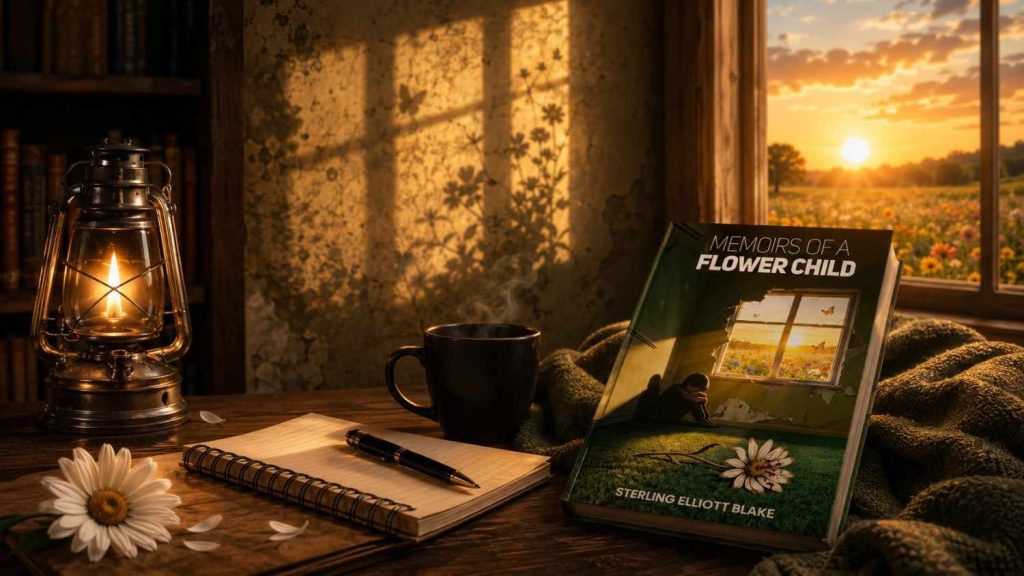
Some people smooth their stories over before writing them down. Not Sterling. Sterling Elliott Blake grew up in a world that promised freedom and, honestly, gave him chaos instead. We’ll get to the book in a minute. First, though, a bit about the man, because none of this started on a page. It started in Long Beach, California, back in the mid 1960s.
Sterling Elliott Blake Touches Hearts by sharing his life with honesty, resilience, and a quiet strength that stays with readers long after the final page.
How Sterling Elliott Blake Found His Way Into Writing
Born June 22, 1961. His mom was part of the hippie movement. His dad carried around a lot of anger. Two very different kinds of chaos, and Sterling landed right in the middle of both. At seven, his mother handed him marijuana like it was nothing. Not the detail you’d expect from a story about the sixties, right? But it happened. He doesn’t dress it up, and he doesn’t pretend it didn’t.
A Prediction He Refused to Accept
At nine, staying at the Albert Sitton Home, a counselor looked at him and said it plainly: no future, probably prison. Try sitting with that as a nine-year-old. Sterling didn’t buy it, though. Looking back now, that one sentence is basically what turned him into the childhood trauma survivor story author he’d eventually become.
Building a Different Life
So here’s what he did instead. A Master of Business Administration. Two Bachelor’s degrees in Electronic Engineering. Three Associate degrees stacked on top of that. Somewhere in there, he even earned a Master rank in Kung Fu San Soo, which, honestly, feels like its own separate story. He spent years working as a Process Engineer in Aerospace and Defense. None of it erased what happened to him as a kid. It just proved the counselor wrong, piece by piece.
His mentor wasn’t really a person, if you think about it. It was that grim prediction. He turned it into fuel instead of a verdict. Then came grief, more than anyone should have to carry. Sterling lost both of his sons, and for a while he got close to giving up completely. He didn’t, though. He kept going, leaning on his faith and on his daughter, who still calls him Papa. Long before it existed as a True Story Memoir of Childhood Trauma, this was just a man refusing to quit, over and over, on days no one was watching.
That refusal is really what pushed this childhood trauma survivor story author toward the page in the first place. He wasn’t chasing a writing career. He just had something that needed saying, and he wanted to say it straight, without the usual polish.
Memoirs of A Flower Child: A Childhood the World Wasn’t Meant to See
So, the book. Memoirs of A Flower Child pulls the curtain back on what the so-called Summer of Love actually cost the kids stuck inside it. Forget the peace signs and the flower crowns for a second. This is what was happening behind them.
Inside the Story
Sterling tells it in a non-linear way, bouncing between himself as a kid and himself as a grown man. In one chapter, he’s a boy facing beatings, neglect, and drug exposure way too young. A few pages later, he’s a grown man burying his own sons. That back and forth is a big part of why people keep calling it an inspiring true story of survival and hope instead of just another sad retelling. As a True Story Memoir of Childhood Trauma, it’s not fishing for sympathy at all. It just puts you inside a real childhood and leaves you sitting there, which is uncomfortable on purpose, and a lot more honest than a story someone built just to make you cry.
An Inspiring True Story of Survival and Hope
Why does it land the way it does? Mostly because none of the hope in it comes free. This book doesn’t hand anything over easily. Sterling doesn’t perform his pain for the reader, and he’s not fishing for pity either. What he’s offering instead is proof, plain and simple, that a rough start doesn’t get to write the ending.
There’s actual research behind this too, not just one man’s anecdote. The CDC ran its Adverse Childhood Experiences study with Kaiser Permanente back in the late 1990s, and it found that early trauma can shape a person’s health and behavior well into adulthood. Sterling’s story doesn’t argue with any of that. It just shows, up close, what outworking it can actually look like.
Which is probably why readers keep describing him as a genuine childhood trauma survivor story author, not just another memoirist with one sad chapter. He’s not writing from theory here. He’s writing from a childhood he actually lived through, and that’s a completely different kind of credibility. As an inspiring true story of survival and hope, the book earns that label the hard way. Nobody handed it to him.
If you’re after an honest True Story Memoir of Childhood Trauma, blunt where it needs to be and quiet where it counts, this is it. And that’s exactly why so many readers keep calling it an inspiring true story of survival and hope worth passing along to someone else who needs it.
Frequently Asked Questions
Who is Sterling Elliott Blake? A childhood trauma survivor story author from Long Beach, California, who spent decades proving a bad prediction wrong, one degree and one hard day at a time.
What is Memoirs of A Flower Child about? A non-linear memoir that follows Sterling’s childhood inside the hippie movement, along with everything that came after, the losses included.
Is this book only about the 1960s? Not really. Sure, Sterling built it as a True Story Memoir of Childhood Trauma that mostly happens in that decade, but the grief and rebuilding in it stretch a lot further than that.
Why do readers call it an inspiring true story of survival and hope? Because Sterling doesn’t skip the hard parts. That’s really the whole reason the hope at the end feels earned instead of scripted.
Conclusion
So here’s the short version. This childhood trauma survivor story author proves something pretty simple: a rough beginning doesn’t get to decide the ending. Sterling Elliott Blake’s mix of lived experience and plain stubbornness gave him something a lot of writers never get: a story that never needed dressing up to matter. He still lives by the same instinct that got him through the Albert Sitton Home all those years back. Keep going. One honest day at a time, even when that’s the hardest thing available.
If you’re after a True Story Memoir of Childhood Trauma that treats you like an adult, Memoirs of A Flower Child is worth the time. It’s proof, plain and simple, that survival and hope can sit on the very same page.
One more thing worth saying clearly. This book touches on childhood abuse, grief, and suicidal thoughts. If any of that hits close to home for you, please know support exists, and a mental health professional or a crisis line is a solid place to start.