
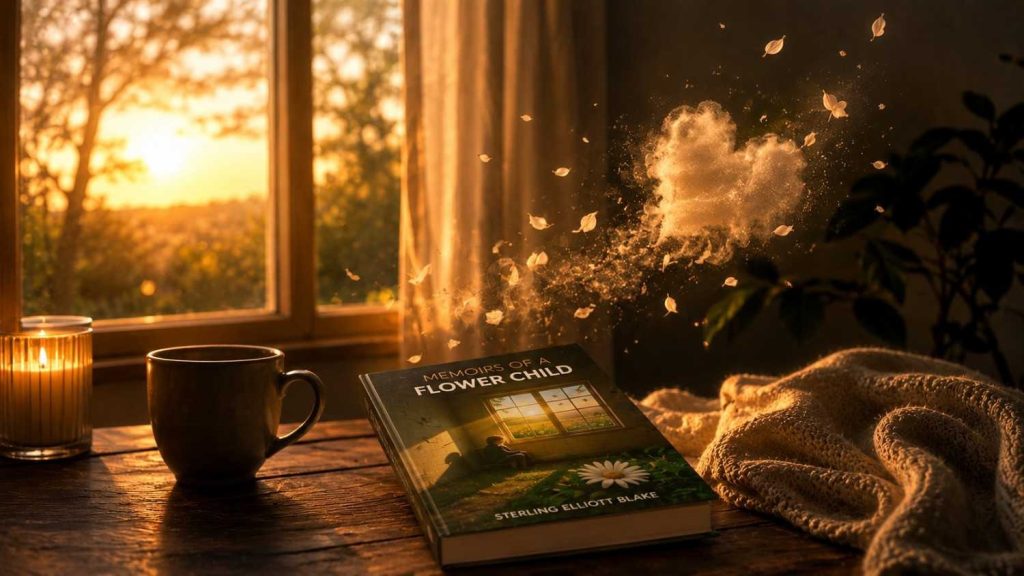
Some stories get polished before they reach a reader. This one didn’t need it. Sterling Elliott Blake grew up inside the hippie movement. But what he lived through looks nothing like the peace signs most people picture from that era. The author of Memoirs of A Flower Child didn’t clean any of it up for the page. Instead, Memoirs of A Flower Child is his answer to that gap. It’s a book written by someone who actually survived what the 1960s left out of the postcard version.
Memoirs of A Flower Child: The Story Sterling Had to Tell
It’s helpful to know the man behind the book before reading the book itself. Sterling was born in Long Beach, California, in 1961. His mother belonged to the hippie movement. His father, however, harbored a great deal of anger. And Sterling was raised in the midst of two distinct types of chaos. They were both rough.
A Childhood That Shaped Everything
His mom gave him some pot at the age of seven. Then, at age 9, he was staying at the Albert Sitton Home and was told by a counselor that there was no way he was going to have a future. He’d likely end up in prison, the counselor said. It was a hard message for the child to hear and had long-term effects on him. That wouldn’t do for Sterling, however. Rather, he resolved, at that very moment, to show the prediction to be false, if that could take a long time, decades.
Building Something Different
So what was he doing then? He has a Master of Business Management degree, two Bachelor’s degrees in Electronic Engineering and three Associate degrees. Along the way, he also turned into a Master in Kung Fu San Soo, which is truly its own story. After that, he worked for several years as a Process Engineer in Aerospace and Defense, and now semi-retired for decades. None of it blotted out his history. Instead, it just proved what was possible in spite of it, one degree and one promotion at a time.
Why Readers Call It a Memoir About Loss and Survival
The author of Memoirs of A Flower Child didn’t set out to write something inspirational. Instead, he set out to tell the truth. The book moves in a non-linear style, jumping between Sterling as a young boy and Sterling as a grown man. One chapter shows a child facing beatings and neglect. A few pages later, that same man is burying his own sons.
That structure is exactly why so many people describe it as a memoir about loss and survival. It’s not just a straightforward memoir. The losses in this book aren’t tucked into a single sad chapter. Instead, they run through the whole thing, right alongside the moments where Sterling kept choosing to get back up.
What Makes It Different
Plenty of books touch on hard childhoods. Fewer are written by someone willing to sit in the discomfort without softening it. Fewer still admit how long the effects actually lasted. As the author of Memoirs of A Flower Child, Sterling doesn’t ask readers for sympathy. The writing doesn’t reach for it either. It just puts you inside a real childhood and lets you stay there for a while. That’s long enough to understand why he writes the way he does.
Researchers have actually studied this pattern for decades. The CDC ran its Adverse Childhood Experiences study with Kaiser Permanente back in the late 1990s. It found that early trauma can shape a person’s health and choices well into adulthood. That’s not a small thing to know if you grew up the way Sterling did. Still, Sterling’s story doesn’t argue with that research. It simply shows what pushing through it can look like in one real-life, degree by degree and year by year.
An Honest Overcoming Childhood Abuse Memoir
That’s really what this is: an overcoming childhood abuse memoir. It refuses to smooth over the hard parts just to make readers comfortable. Sterling doesn’t perform pain for effect, and he doesn’t dress up his story to seem more dramatic than it already was.
Readers who’ve lived through something similar often say the book gave them language for things they’d never spoken out loud. That’s a rare thing for any memoir to do. It’s even rarer when it’s written by someone who spent decades quietly building a completely different kind of life.
It also works well for readers who haven’t lived anything close to Sterling’s childhood. The themes here go beyond one childhood, though. Perseverance, faith, and refusing to accept someone else’s prediction for your life reach a lot further than one man’s story from Long Beach.
Frequently Asked Questions
What is Memoirs of A Flower Child about? It’s a non-linear memoir following Sterling Elliott Blake’s childhood inside the hippie movement. It also covers the losses and choices that shaped his adult life.
Who wrote this book? The author of Memoirs of A Flower Child is Sterling Elliott Blake. He’s a survivor of a difficult 1960s childhood who went on to build a career in engineering and a life grounded in faith.
Is this only a memoir about loss and survival, or does it cover other things? Loss and survival run through it. But the book also covers education, career, and faith. It also gets into what it actually takes to keep going after everything falls apart, including the years most memoirs skip right over.
Why do people call it an overcoming childhood abuse memoir? Because it doesn’t skip the hard parts. That honesty is exactly what makes the survival at the center of it feel earned instead of scripted.
Conclusion
In the end, Memoirs of A Flower Child proves something simple. A rough beginning doesn’t get to write the ending. Sterling’s mix of lived experience and quiet stubbornness gave him something most writers never get. It’s a story that never needed embellishing to matter. He still lives by the same instinct that got him through the Albert Sitton Home all those years ago: keep going, one honest day at a time. Even now, that instinct is sometimes the only thing he’s got.
If you’re looking for a memoir about loss and survival that treats readers like adults, this one delivers exactly that. And if you want an overcoming childhood abuse memoir that earns every bit of hope it offers, this is it.
One more thing worth saying clearly. This book touches on childhood abuse, grief, and suicidal thoughts. If any of that hits close to home, please know support is available. A mental health professional or a crisis line is a solid place to start.